
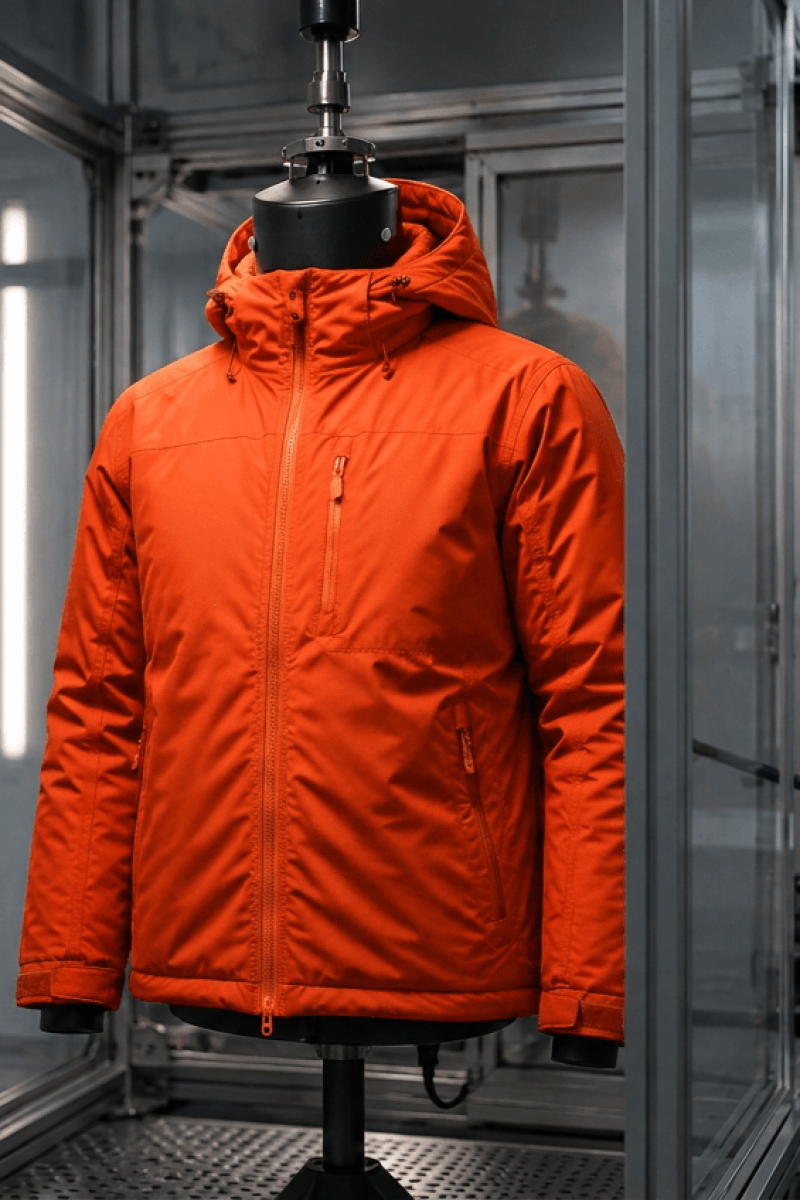
When comparing insulation materials, one of the most frequently quoted performance indicators is the CLO value.
Although widely used within the textile industry, CLO is often misunderstood. It is sometimes assumed that a higher CLO automatically means a better insulation material.
In reality, CLO is only one part of the overall performance picture.
To select the right insulation, product developers should evaluate CLO together with thickness, weight, moisture management, air permeability and the requirements of the finished product.
A CLO value is a standardised way of expressing the thermal insulation provided by clothing or insulation materials.
Higher CLO values indicate greater resistance to heat loss under controlled laboratory conditions.
The CLO system allows insulation materials to be compared using a common reference rather than relying only on weight or thickness.
It is therefore one of the most useful tools when evaluating thermal insulation performance.
Without a standard measurement, comparing insulation materials becomes difficult.
Two materials may have:
Yet provide very different thermal performance.
CLO values make these differences easier to understand by measuring the insulation effect rather than simply describing the construction.
Although CLO is an important measurement, it should never be used alone.
Real-world performance is also influenced by:
Two insulation materials with similar CLO values may perform differently once incorporated into finished products.
Laboratory measurements should therefore always be interpreted together with practical application requirements.
One common misconception is that heavier insulation is automatically warmer.
In practice, thermal efficiency depends on how effectively the insulation traps still air.
Modern microfibre constructions can often achieve high CLO values without requiring excessive thickness or weight.
For many product developers, the objective is therefore not the highest CLO value alone, but the highest thermal performance relative to weight and thickness.
Different applications prioritise different performance characteristics.
For example:
A winter glove may prioritise:
A sleeping bag may prioritise:
A safety boot may prioritise:
The required CLO value therefore depends on the intended application rather than a universal target.
Within the MEIDA insulation platform, CLO values are used as one of several methods for evaluating thermal performance.
MEIDA Original has been developed to achieve high thermal efficiency within a relatively thin construction, making it particularly suitable where space is limited.
MEIDA Soft combines thermal performance with additional loft and softness.
MEIDA Ceramic builds on the same insulation platform while integrating FIR functionality.
MEIDA Clima approaches thermal comfort differently through active temperature regulation using PCM technology rather than increasing insulation value.
Professional material selection should never rely on a single number.
A complete evaluation should also consider:
Understanding the relationship between these characteristics leads to better product development decisions than comparing CLO values alone.
A CLO value is a standardised measurement used to describe the thermal insulation provided by clothing and insulation materials.
CLO is a unit used in textile insulation to express thermal insulation performance under controlled laboratory conditions.
Not necessarily. The best CLO value depends on the intended application, available space and overall product design.
CLO values are determined using recognised thermal testing methods under controlled laboratory conditions.
They provide an objective method for comparing insulation materials.
Yes. Fibre technology and construction influence thermal efficiency.
Yes. Modern microfibre insulation systems can provide high thermal efficiency without excessive thickness.
No. CLO and Rct both describe thermal insulation but use different units and testing approaches.
Neither is better. Both provide useful information and are often used together.
CLO provides valuable laboratory data, but real-world warmth also depends on garment design, moisture, wind and user activity.
The measured CLO value describes the insulation material, while the finished product performance depends on the complete construction.
Yes. Compression reduces the amount of trapped air available for insulation.
Moisture influences thermal comfort and product performance even when the laboratory CLO value remains unchanged.
There is no universal “good” CLO value. The appropriate level depends on the intended application.
MEIDA Original is designed to provide high thermal performance while maintaining a thin, lightweight construction.
Yes. Gloves often require high thermal performance within very limited space.
Yes. Thermal performance is an important consideration in insulated footwear, particularly where product thickness is limited.
Because thermal comfort also depends on moisture management, air permeability, thickness, weight and overall product construction.
Yes. Together they provide a more complete understanding of thermal insulation performance.
Technical performance data is available in the individual MEIDA product datasheets.
Whether you’re developing apparel, footwear, gloves or bedding, our specialists are ready to help.